Find the breakthrough compounds hiding in chemical space
Download the guide and learn what generative chemistry is, where it fits in the discovery workflow, and best practices to avoid common pitfalls.
How can I predict binding affinity without a target protein structure?
Why traditional ligand-based QSAR methods have fallen short You might be sceptical about ligand-based QSAR approaches; many researchers are. We discussed why there has…
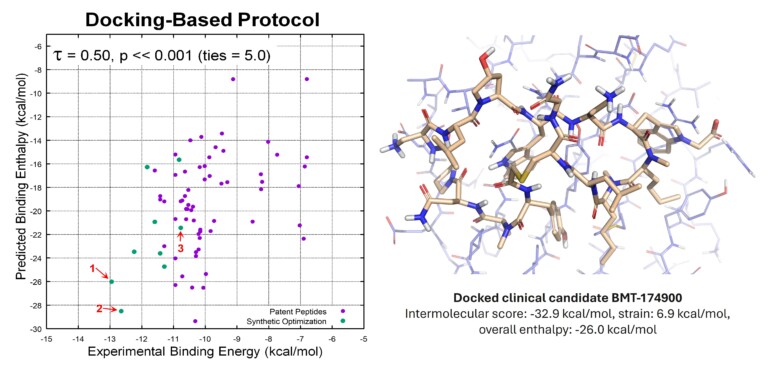
Ensemble-based conformational modelling for macrocycles
From X-ray refinement to lead optimisation Conventional ligand-fitting and refinement methods in X-ray electron density maps often yield models with…
Share your science, not your secrets: How StarDrop 8 supports collaboration with CROs
The collaboration challenge: Where generic tools fall short Several collaboration platforms have been designed to support molecule design and optimisation.…
Looking beyond statistics: How do I determine whether a QSAR model will add value to my project?
Good statistics don’t guarantee good applicability. Performance metrics will tell you how well a QSAR model predicts known data, but they don’t tell you whether it will add practical value…
Enhanced ADME predictions : New and improved models in StarDrop 8
All models are available in StarDrop’s ADME QSAR module: pKa– Most acidic pKa– Most basic pKa– All pKa valueslogP (Octanol/Water)logD7.4 (Octanol/buffer…
Counting what counts: Structural descriptors in StarDrop
In medicinal chemistry, it’s often the little things, like the subtle changes in a molecule’s structure, that make the difference.…
Real-time collaboration for molecule design: Why medicinal chemists need more than just shared documents
Imagine if everyone on your team could stay in sync with the latest compounds and data, working with the same…