StarDrop™ 8.1 marks the first release under our new, shorter development cycle, and it’s a signal of how we intend to keep pace with the demands of modern discovery workflows.
This release brings meaningful improvements to protein visualisation, data filtering, and column and row management: refinements grounded in customer feedback that make a real difference to how scientists work with data every day.
It feels like only yesterday that we announced the arrival of StarDrop 8. And here we are again. Though this time, that’s rather the point.
Discovery teams need to iterate quickly, moving from hypothesis to decision with speed and confidence. The tools they rely on need to keep pace.
That’s why we’ve evolved how we develop and deliver updates. Rather than waiting for large, infrequent releases, we are now working in shorter development cycles – so new features and usability improvements reach you faster.
StarDrop 8.1 is the first release under this new model, and it highlights how these faster cycles can deliver meaningful improvements to the everyday user experience.
While major projects will continue over multiple development cycles, some of the most valuable changes are the smaller ones that make working with data smoother, clearer, and more enjoyable.
Here are three examples:
Improved structure-based design with new secondary structure visualisations
Protein structures are easier to interpret when the visualisation is both clear and intuitive. StarDrop’s 3D view lets you explore protein structures directly alongside your compound data and scoring, meaning you don’t have to switch between tools during design and optimisation.
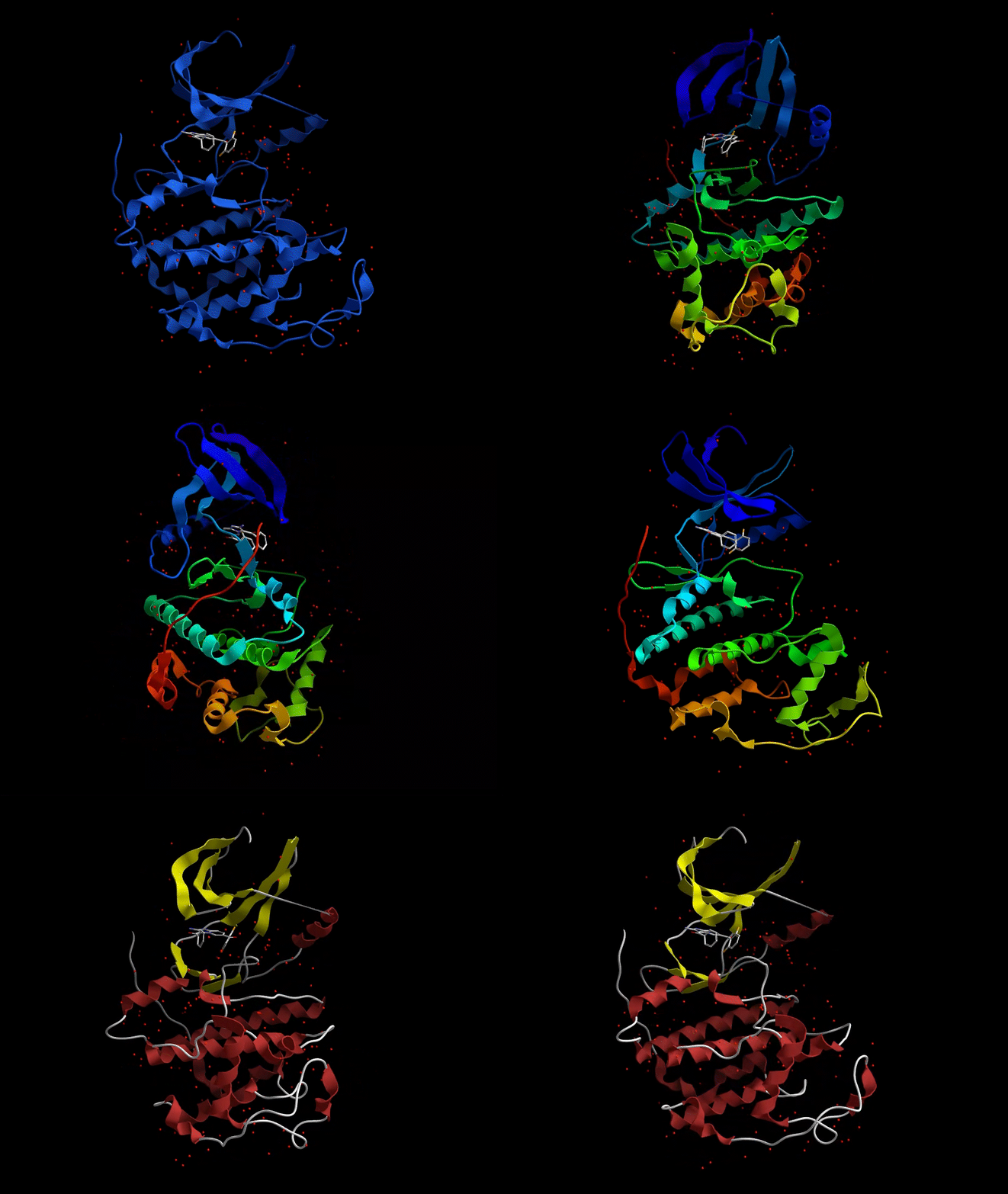
StarDrop 8.1 introduces secondary structure ribbons for protein visualisation, providing a familiar and visually appealing way to explore structural context.
These ribbon representations make it easier to distinguish key elements such as helices, sheets, and loops at a glance. The result is a clearer understanding of the binding environment and protein architecture when exploring structure-based design within StarDrop. This means you can make informed design decisions without leaving your analysis environment.
And, frankly, they look great and the graphics performance is superb.
3D visualisation of the CDK2 kinase, 1PYE, in StarDrop 8.1, including new secondary structure ribbons.
Improved column and row freezing
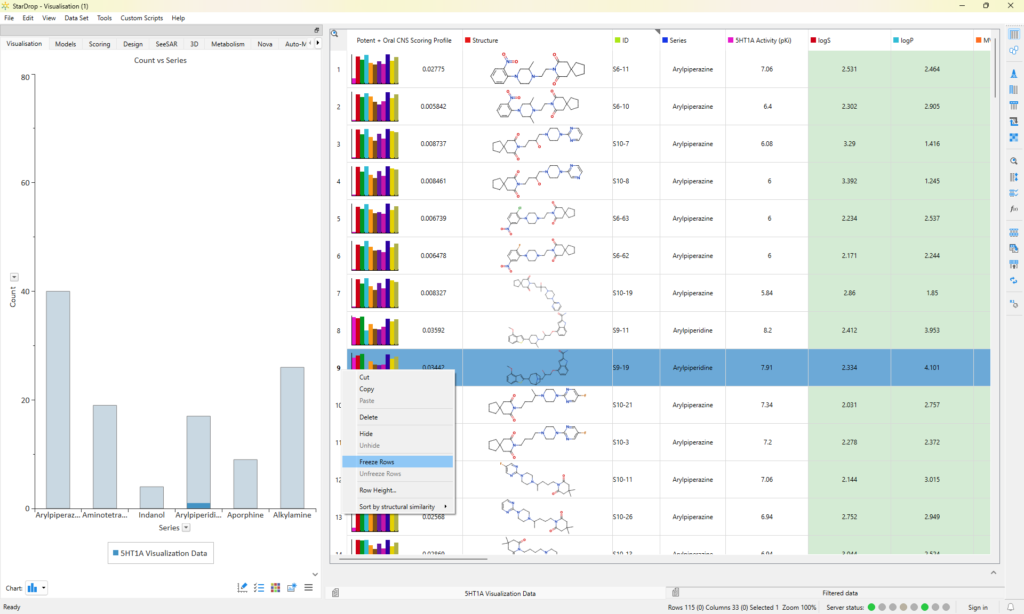
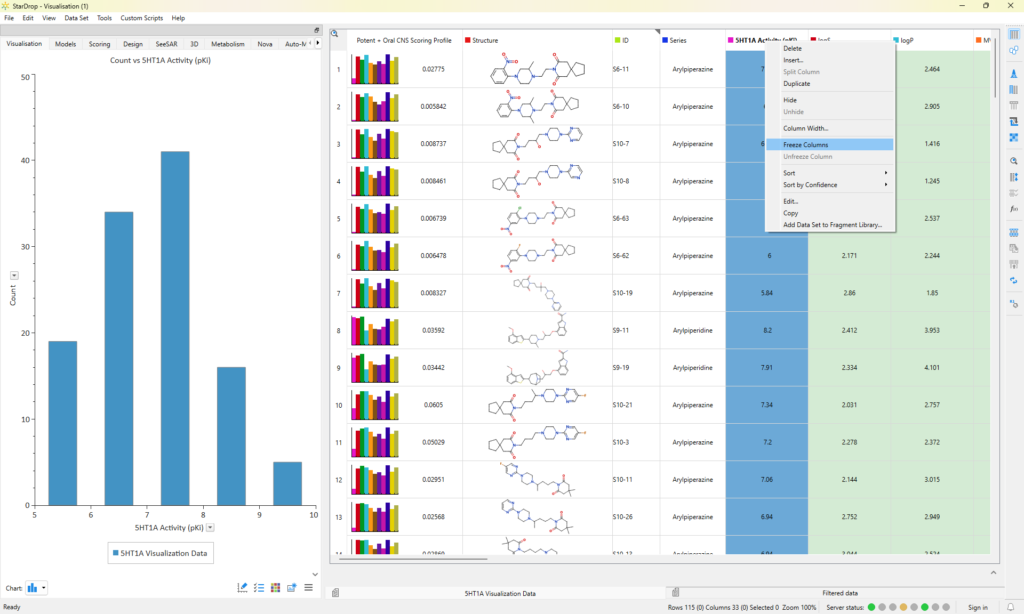
Anyone who works with large compound datasets knows the value of keeping key identifiers visible while exploring data. StarDrop 8.1 improves the experience of freezing columns and rows, making it easier to lock important fields and giving you more control over the way you view your data.
You can now freeze one or more rows or columns and add additional rows or columns to your frozen set at any time without replacing those already frozen. Similarly, unfreezing can now be applied selectively to chosen rows or columns within the frozen set.
To further improve usability, freeze and unfreeze actions are now accessible directly from the context menu when right-clicking a row or column header, making them quicker and more intuitive to use.
StarDrop 8.1 makes it easier to navigate large datasets with more control over column and row freezing.
A better filtering experience
Filtering data is one of the most common tasks in medicinal chemistry analysis, whether you’re triaging compounds, narrowing down series, or searching for interesting patterns. Several enhancements in StarDrop 8.1 improve the usability and flexibility of data filtering.
You can now continue to navigate your data while adding or modifying a filter. The filter panel remains open while you move between datasets, dynamically updating to reflect the currently active data set. The filter panel now also remains open after applying a filter, making it faster and easier to refine or modify your criteria.
Additional fates for filtered rows have been introduced. In addition to the existing options (Select, Delete, and Move to a new data set), users can now choose to Tag,Show only filtered or Hide filtered compounds, providing more ways to focus on relevant data.
Driven by customer feedback
These improvements share something in common: each one was shaped by how scientists actually use StarDrop in the field. StarDrop has always evolved in close collaboration with our customers, and these enhancements reflect the practical needs of real discovery workflows.
Want to learn more?
All updates to StarDrop 8.1 are detailed in the release notes.
If you’d like to try StarDrop’s molecule design, optimisation, and data analysis capabilities for yourself, then request your free demo here.
About the author
Rae Lawrence, PhD
Product Manager
Rae holds a PhD in Theoretical Chemistry from the University of Missouri-Columbia.
After 2 years at the helm of Optibrium’s super-star software development team, she made a lateral move within the organisation to focus more on planning and scoping the products and technologies of the future.
As Product Manager, she leverages over two decades of experience in software development, applications science, and business development—including valuable time spent as a customer. Rae serves as the crucial “universal translator,” adeptly converting customer requirements into technical specifications that enable our developers to deliver effective solutions to complex problems