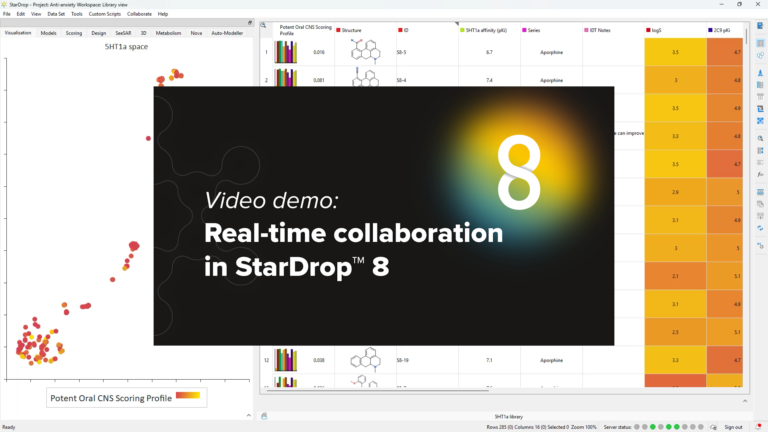
Real-time collaboration in StarDrop 8
See how StarDrop integrates powerful real-time collaboration into every stage of the molecule design and optimisation workflow. This ensures your…
In this study, the researchers look to solve classification quantitative structure−activity relationship (QSAR) modelling problems using Gaussian processes.
They cover two different approaches, describing how these methods work and applying them to build category models of target activity data and absorption, distribution, metabolism, excretion, toxicity (ADMET) properties. They compare this Gaussian processes method to other computational modelling methods, including decision trees, random forest, support vector machines, and probit partial least squares. Whilst none of the methods were consistently best, Gaussian processes often produced better models than random forest or support vector machines and was rarely significantly outperformed.
O. Obrezanova and M. D. Segall, J. Chem. Inf. Model., 2010, 50 (6), pp 1053–1061.
DOI: 10.1021/ci900406x
You can download an e-print of this article on Gaussian processes via the ACS “Articles on Request” service using the following link:
http://pubs.acs.org/articlesonrequest/AOR-e9ivq4kdydbtNGCKt9Nw
Please note: To access the Articles on Request link, please log in to the Publications website using your ACS ID. If you do not have an ACS ID, you will need to create one using this link.
See how StarDrop integrates powerful real-time collaboration into every stage of the molecule design and optimisation workflow. This ensures your…
Version This script is for the latest version of StarDrop for either Windows or Mac. To find out which version you have…
This StarDrop script estimates free fraction (fᵤ) in microsomes, hepatocytes, and plasma from experimental data in other media, experimental logD…