The challenge
Macrocyclic peptides are an exciting class of compounds for tackling previously undruggable targets. However, their size and conformational complexity make systematic lead optimisation very challenging, typically requiring scientists to make and test thousands of compounds in a complex and resource-intensive process.
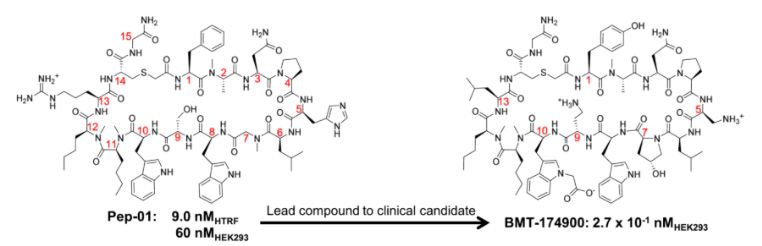
In collaboration with Bristol Myers Squibb (BMS), we used the PD-1/PD-L1 system as a retrospective example. The path from lead compound Pep-01 to clinical candidate BMT-174900 required modifications at 6 positions within a 15-residue macrocycle. Conservative exploration would require chemists to make over 7,000 analogues, with systematic exploration requiring over 750,000 compounds.
The BioPharmics approach
Identifying bioactive conformations with NMR restraints
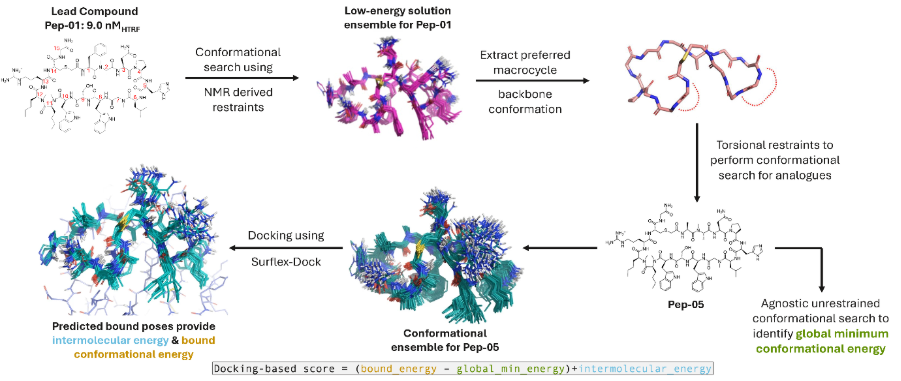
ForceGen’s deep conformational search applied NMR-derived distance and torsional restraints to accurately identify the bioactive conformation of Pep-01. The solution ensemble was pre-organised for PD-L1 binding, with the closest conformer matching the crystallographic bound state within 0.9 Å RMSD.
Guided conformational search for new analogues
We used the torsional backbone restraints derived from this NMR-validated bioactive structure to generate relevant 3D conformations for a set of 72 analogues, focusing computational exploration on biologically relevant regions of conformational space.
Structure-based compound prioritisation
Surflex-Dock molecular docking ranked all 72 analogues and accurately predicted bound ligand poses while incorporating molecular strain to identify global minimum energies (more on the importance of strain below).
The importance of molecular strain
Bound ligand strain was a key factor in determining binding energies, explaining the largest fraction of activity variation among analogues. While small structural modifications caused minimal changes in protein-ligand interactions, they often produced large changes in strain that dominated overall binding energy. Single-atom modifications yielded activity losses of up to 3 log units.
The results
The clinical candidate BMT-174900 ranked in the top 10% of compounds, translating to a potential 90% saving in synthetic efforts. This represents potential savings of thousands of synthesis and testing cycles, months of calendar time, and significant cost reduction in synthetic chemistry and biological assay resources.
Summary and prospective application
This collaboration with BMS validates BioPharmics as a practical approach to macrocycle lead optimisation with quantifiable efficiency gains. The key to success lies in three elements: rigorous conformational search capable of handling macrocyclic size and flexibility, effective integration of biophysical data to guide predictions, and accurate modelling of ligand strain.
Its industry-leading 3D modelling technology enables effective evaluation and prioritisation in hit-to-candidate workflows. This transforms a previously intractable challenge into an efficient, data-driven process that can save potentially 90% of synthetic efforts.
Link to the full publication to learn more: https://doi.org/10.1007/s10822-023-00524-2